The Ultimate Showdown: Helpdesk Software vs Ticketing Software Whats The Difference for 2026
In 2026 the lines between different customer support tools have become blurrier and more strategic. Organizations in the electronics sector — from component distributors and consumer device manufacturers to repair shops and IoT service providers — must choose the right support platform for increasingly complex needs. Two phrases often appear in procurement conversations: helpdesk software and ticketing software. They are related, sometimes overlapping, but distinct in scope, purpose, and the outcomes they enable.
Introduction: why the distinction matters now
At first glance, a ticket is a ticket: a customer writes, an agent responds, and the issue is resolved. But as devices become smarter, product lifecycles shorten, and omnichannel expectations rise, the platform choice affects operational cost, customer satisfaction, and even product design feedback loops. By 2026, many sellers and service providers expect integrated AI-driven support, predictive maintenance hooks, and tighter product-to-support telemetry than ever. Making the right architectural choice between a focused ticketing system and a broader helpdesk platform can be the difference between reactive problem handling and proactive, revenue-supporting service.
Defining terms: what each category typically means
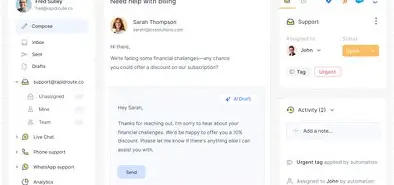
Ticketing software refers to tools oriented around creating, tracking, routing, and resolving discrete issues. Its core value is workflow: capture, prioritize, assign, escalate, and close. Ticketing systems excel at process, SLAs, queues, and high-volume case throughput.
Helpdesk software usually encompasses ticketing functionality but extends into customer-facing portals, knowledge bases, chatbots, self-service, reporting dashboards, and often basic CRM capabilities. Helpdesk platforms are designed to manage the entire support experience — not just an individual ticket.
Detailed analysis: features, architecture, and practical differences
This section compares the two by functional area and describes what buyers should look for in 2026.
1. Core workflow and incident management
Ticketing systems focus on workflow controls: ticket routing rules, SLA timers, priority matrices, escalation paths, and audit trails. For organizations with well-defined processes (for example, an electronics manufacturer’s RMA team), these tools provide predictable throughput and compliance evidence.
Helpdesk software includes the same workflow features but layers them with case context — customer profiles, product history, asset tracking, and conversation threads that span channels. For complex problems that require cross-team collaboration (engineering + firmware + logistics) a helpdesk’s contextual links reduce friction.
2. Channels and omnichannel support
Modern ticketing solutions handle email and form submissions well, and many have added messaging connectors. Helpdesk platforms, however, are more likely to provide a unified omnichannel view with integrated chat, SMS, social, voice, and in-app support. In electronics retail, where customers might open a case from a mobile app, social DM, or before a repair appointment, the omnichannel continuity in a helpdesk reduces redundant steps.
3. Self-service, knowledge base, and AI
Ticketing systems may offer a simple FAQ or macro responses to speed agent replies. By 2026, helpdesk platforms typically bundle advanced self-service features: AI-powered knowledge retrieval, contextual troubleshooting guides, and embedded decision trees for field technicians. These capabilities lower ticket volume and increase first-contact resolution — especially important for warranty and basic troubleshooting requests in electronics.
4. Integrations and telemetry
Ticketing tools integrate with email, chat, and basic CRM. Helpdesks are designed for broader integrations: product telemetry, order systems, ERP, licensing servers, and even device health APIs. For IoT and consumer-electronics firms, a helpdesk that can ingest device diagnostics (battery cycles, error logs) and attach them to a support case transforms troubleshooting and shortens repair cycles.
Find top-rated Electronics products at great prices.
Shop Amazon →5. Reporting, analytics, and continuous improvement
Standard ticketing reports include response times, volume by queue, SLA breaches, and agent productivity. Helpdesks add customer journey analytics, cohort-based churn signals, product-fault heatmaps, and AI-driven root-cause analysis. Organizations concerned about lifecycle costs, returns, or design feedback will benefit from helpdesk analytics that tie support outcomes to product SKUs and firmware versions.
6. Security, compliance, and multi-tenancy
In regulated contexts or when supporting enterprise electronics customers, security matters. Both classes offer role-based access controls and encryption, but helpdesk platforms more frequently support multi-tenant deployments, granular data segmentation, and audit-ready logs — useful for MSPs serving multiple clients or manufacturers handling partner support.
Real-world use cases
Understanding how teams use each category clarifies which is appropriate.
- High-volume consumer support (ticketing): A consumer electronics warranty returns team that processes thousands of simple replacement requests daily benefits from a lean ticketing system focused on throughput, templated responses, and SLA enforcement.
- Field service orchestration (helpdesk): A B2B hardware vendor coordinating on-site repairs, spare parts logistics, and firmware updates needs asset tracking, dispatch, and in-app case updates that a helpdesk provides.
- IoT device diagnostics (helpdesk): A smart-home device company that attaches device telemetry to cases to allow remote troubleshooting and predictive replacement gains efficiency from a helpdesk integrated with device APIs.
- Internal IT service (either, depending on scope): Small IT departments may use a ticketing tool for basic incident management. Larger ITSM-aligned operations should opt for helpdesk platforms with change management and CMDB features.
- Retail POS support (ticketing + integrations): A retailer dealing with till outages during peak hours needs an extremely fast ticketing workflow and integrations to incident broadcast systems; they may later add helpdesk features as complexity grows.
Pros & cons
Ticketing software — pros & cons
- Pros:
- Simple, predictable workflows for high-volume scenarios
- Lower initial cost and faster deployment
- Easy to train new agents on focused ticketing workflows
- Strong SLA and audit trail capabilities
- Cons:
- Limited contextual customer or product data
- Not optimized for omnichannel or proactive support
- Less suited to complex, cross-functional escalations
- Fewer advanced analytics and AI features
Helpdesk software — pros & cons
- Pros:
- Holistic customer context and asset tracking
- Built-in self-service, knowledge bases, and AI assistants
- Better for omnichannel, field service, and device telemetry
- Advanced reporting ties support trends to product data
- Cons:
- Higher cost and longer implementation timelines
- More configuration and potential feature bloat for simple teams
- Requires governance to avoid inconsistent processes across teams
- May demand integrations and data hygiene efforts up front
Side-by-side comparison
| Capability | Ticketing Software | Helpdesk Software |
|---|---|---|
| Primary purpose | Manage discrete issues and ticket workflows | Manage the full support experience and customer lifecycle |
| Channels | Email, forms, basic chat integrations | Omnichannel: email, chat, voice, SMS, social, in-app |
| Self-service | Minimal or add-on | Built-in knowledge base, AI assistants, decision trees |
| Telemetry & integrations | Limited | Extensive (device data, ERP, CRM, supply chain) |
| Reporting & analytics | Basic operational metrics | Customer journeys, product failure analytics, predictive insights |
| Best for | High-volume, low-complexity support teams | Complex support operations, product-driven support, MSPs |
| Typical pricing model | User or seat-based, lower tiers | Seat + feature tiers, often add-ons for advanced integrations |
Buying guide: what buyers in electronics care about in 2026
Electronics companies evaluate support platforms with both customer experience and product lifecycle needs in mind. The following checklist helps decision-makers align vendor capabilities to business goals.
1. Clarify the support mission
Decide whether the primary goal is volume handling (e.g., returns, simple RMA), deep technical troubleshooting, or a mix. High-volume transactional needs can be satisfied by ticketing. Product-feedback loops and field service needs usually justify a helpdesk.
2. Map product and asset data requirements
Does the support team need to see serial numbers, firmware versions, warranty state, and sensor logs? If yes, choose a solution that supports asset models and telemetry ingestion.
3. Prioritize SLAs, compliance, and security
For enterprise or regulated customers, confirm role-based access, encryption standards, data residency options, and audit logging. Check whether multi-tenant isolation is required for channel partners or MSPs.
4. Assess omnichannel and customer journey continuity
Customers expect continuity across channels. Confirm that the platform preserves context when conversations switch from chat to phone or from app to web portal.
5. Evaluate automation and AI capabilities
Ask for concrete examples: automated triage scripts, AI-generated suggested replies, and knowledge suggestion rates. For electronics, AI that surfaces relevant troubleshooting steps based on device telemetry significantly reduces mean time to resolution (MTTR).
6. Integration and extensibility
Check for APIs, webhooks, SDKs, and pre-built connectors to ERPs, order systems, defect-tracking, and device platforms. Integration effort is often the largest portion of total cost of ownership.
Shop the latest Electronics picks on Amazon.
View Offers →7. Total cost of ownership and licensing
Look beyond headline license fees. Include professional services, integration, data migration, and the cost of any add-on modules (telemetry, voice, field service). Consider SaaS vs self-hosted options based on security and latency needs.
8. Implementation and onboarding
Confirm vendor-provided implementation support, training resources, and templates for common workflows. For mid-sized electronics firms, projected time-to-live support can determine which solution is feasible.
9. Future-proofing: roadmap and vendor stability
Ask about the vendor’s roadmap for AI, device integrations, and platform interoperability. Ensure the vendor supports standards (e.g., open APIs, SAML, SCIM) so integrations remain stable as the company scales.
10. Pilot and measure
Run a short pilot focused on KPIs: first-contact resolution, average handling time, SLA compliance, and customer satisfaction. Use pilot learnings to refine process mappings before enterprise rollout.
Migration and hybrid approaches
Many organizations find a hybrid path useful: start with a ticketing system to stabilize workflows, then adopt a helpdesk for broader customer experience needs. Alternatively, integrate a ticketing engine with a separate knowledge base and chatbot to achieve helpdesk-like outcomes with less upfront change.
Migration planning should include data model alignment (customers, assets, case history), historical ticket imports, and reworking macros to accommodate richer context. Training and change management are often the difference between feature adoption and unused modules.
2026 trends that influence platform choice
- Embedded AI assistants: LLMs powering context-aware suggested replies and self-service paths are standard. Buyers should evaluate hallucination mitigation and guardrails for troubleshooting guidance.
- Device telemetry integration: Support platforms increasingly act as the bridge between product health signals and customer experience workflows.
- Proactive support: Predictive alerts and automated case creation based on device anomalies reduce downtime and warranty costs.
- Augmented field service: AR-assisted repair workflows and in-app guided diagnostics require helpdesk-level orchestration.
- Privacy and data localization: Global electronics brands must ensure support data flows comply with multiple jurisdictions.
Conclusion
By 2026 the choice between helpdesk software and ticketing software is less about labels and more about outcomes. For teams that primarily need reliable, fast, high-volume case handling, a focused ticketing solution delivers efficiency and predictability. For organizations that must connect device data, orchestrate cross-functional workflows, and improve product-driven support KPIs, a full helpdesk platform offers the features and analytics required to move from reactive to proactive service.
Procurement decisions should start with clearly defined use cases, then map those to capabilities such as telemetry ingestion, omnichannel continuity, AI-assisted self-service, and reporting. Pilots that measure real KPIs and factor in integration effort and total cost of ownership will reveal which path makes sense for a given electronics organization. In many instances, the right answer is pragmatic: deploy what solves the immediate business problem and plan to extend toward a unified helpdesk as product complexity and customer expectations grow.